


One Green Party candidate, Tina Ion, thinks “every single Zionist” should be killed. She also describes Zionists as “vermin” and “rats”. She’s not the only person a little obsessed with Zionists. Camden Green candidate Aziz Hakimi claimed “Zionists” were responsible for 9/11, while in Bournemouth, Feda Shahin claims that “Zionists killed 20 million Christians” in the Soviet Union and that they “love genocide”. Last month, a motion was brought before the Green Party Spring conference to declare that “Zionism is racism” – failing only because they were timed out.
But it is not just the Greens: Your Party’s Zarah Sultana has attacked Jeremy Corbyn for not being anti-Zionist enough, and a week or so ago, a Bristol cafe, which was once on the site of a church, changed its name from the “Zion Community Space” because it was “a barrier” to people coming in. This week in New York – the world’s most Jewish city outside of Israel – protesters shouted “say it loud, say it clear, Zionists are not welcome here”.
There are movements looking to declare areas, such as parts of Leith in Scotland and university campuses, “Zionist free zones”. Meanwhile, Zack Polanski told ITV’s Robert Peston: “I don’t believe any country has a right to exist. People have a right to exist.” Adding: “Semantics about whether a country has a right to exist” was the root cause of the “mess” of the current Israel-Palestinian conflict.
Voltaire argued, “if you wish to converse with me, define your terms”, and there are few words which have a meaning as disputed as Zionism.
For those who identify as pro-Palestinian, Zionism is a political project associated with occupation and settlement expansion and the displacement and marginalisation of Palestinians. But for most Jews in Israel and the diaspora, Zionism remains inseparable from Jewish self-determination and safety after centuries of persecution culminating in the Holocaust. From this perspective, rejecting Zionism entirely can feel like denying the legitimacy of Jewish nationhood itself and they see anti-Zionism as a new form of hatred.
The Oxford dictionary defines Zionism as: “A movement for (originally) the re-establishment of a Jewish nation in Palestine and (now) the development and protection of Israel.” But the recent online battle over the word on Wikipedia shows just how political this definition has become.
Such was the controversy – and the constant silent rows between activist editors who kept changing it – that a moratorium was unusually temporarily imposed, locking the definition. It now reads using its 2024 edit saying: “Zionists wanted to create a Jewish state in Palestine with as much land, as many Jews, and as few Palestinian Arabs as possible.”
Most Jews would not recognise this definition. A “return” to Zion is, for them, a core element of the religious texts Jews have read since the expulsion from Jerusalem in 70AD. The Amidah prayer, recited three times daily, emphasises the yearning to “return” to Zion, while every Passover meal ends with hope, “next year in Jerusalem”.

Zionism started in the late 1800s as Jews were subject to pogroms and expelled from Eastern Europe with more than 100,000 – including some of my ancestors – coming to the UK. This sparked an interest in the British establishment.
George Eliot’s 1876 novel Daniel Deronda is seen as a seminal pre-Zionist text in which Jews are portrayed as people with a culture of their own who deserve to live in freedom in their homeland. The book was one inspiration for Theodor Herzl, the father of Zionism, who set out his own plans to return to the Holy Land after seeing the oppressive antisemitism not only in his homeland of Hungary, but also in enlightened France where he was a witness to the antisemitism after Alfred Dreyfus was falsely convicted of spying for Germany.
Many believe that after the State of Israel was declared in 1948, the word Zionism should have been put to bed
His 1896 pamphlet, Der Judenstaat, elaborating on the visions of a Jewish homeland, attracted growing adherents as countries, including Britain, created laws to stop Jews from coming in. This was a left-wing, secular vision.
The earliest anti-Zionists were in fact Jews, especially in Western Europe, where they were more comfortable and experienced growing emancipation. These anti-Zionists favoured assimilation. Meanwhile, the ultra orthodox have never been Zionists for religious reasons because it is a secular movement. But with Western nations closing their doors to Jews being pogromed across the Russian empire, there was a need for somewhere for them to go. Zionism became the movement to help them.
The famous 1917 Balfour Declaration, favouring “the establishment in Palestine of a national home for the Jewish people”, was one of several conflicting promises to at least three interested parties made over the same parcel of land Britain did not yet control as it sought support for its takeover of Ottoman territory. When Britain did take control, it put limits on Jewish immigration even as the Nazi noose tightened across Europe.
In Mandate Palestine, Zionism was an elastic band of a phrase which included different wings that did not see eye to eye over how to win self-rule. This included the Irgun and Stern Gang, a right-wing paramilitary organisation who used political violence, including the King David bombing of 1946. In these early days, Zionism was championed by the left as an anti-colonialist movement, an expression of self-determination.

After the horrors of the Holocaust, it was clear that Europe was not safe for Jews. Many believe that after the State of Israel was declared in 1948, the word Zionism should have been put to bed. Like the suffragettes and abolitionists, the political dream of Zionism – a Jewish homeland in ancestral lands – had come true. Israel is now a country of nearly 10 million people – 80 per cent of them Jews.
If you believe in a two-state solution and that Israel – a flawed democracy in the Middle East – should be allowed to exist, alongside a Palestinian state, then you would be a Zionist in the word’s broadest sense. But, nearly 80 years on, the word has become tarnished; in the eyes of some, “Zionists” have become a bogeyman; A people who uniquely love war, killing babies, settler colonialism and apartheid.
Anti-Zionism is not a criticism of Israel. Many Jews – including in Israel – are profoundly unhappy with the war in Gaza – which has left 71,000 dead and whole towns and cities destroyed; the way it was fought and the extremist policies of the fascists in Benjamin Netanyahu’s coalition government.
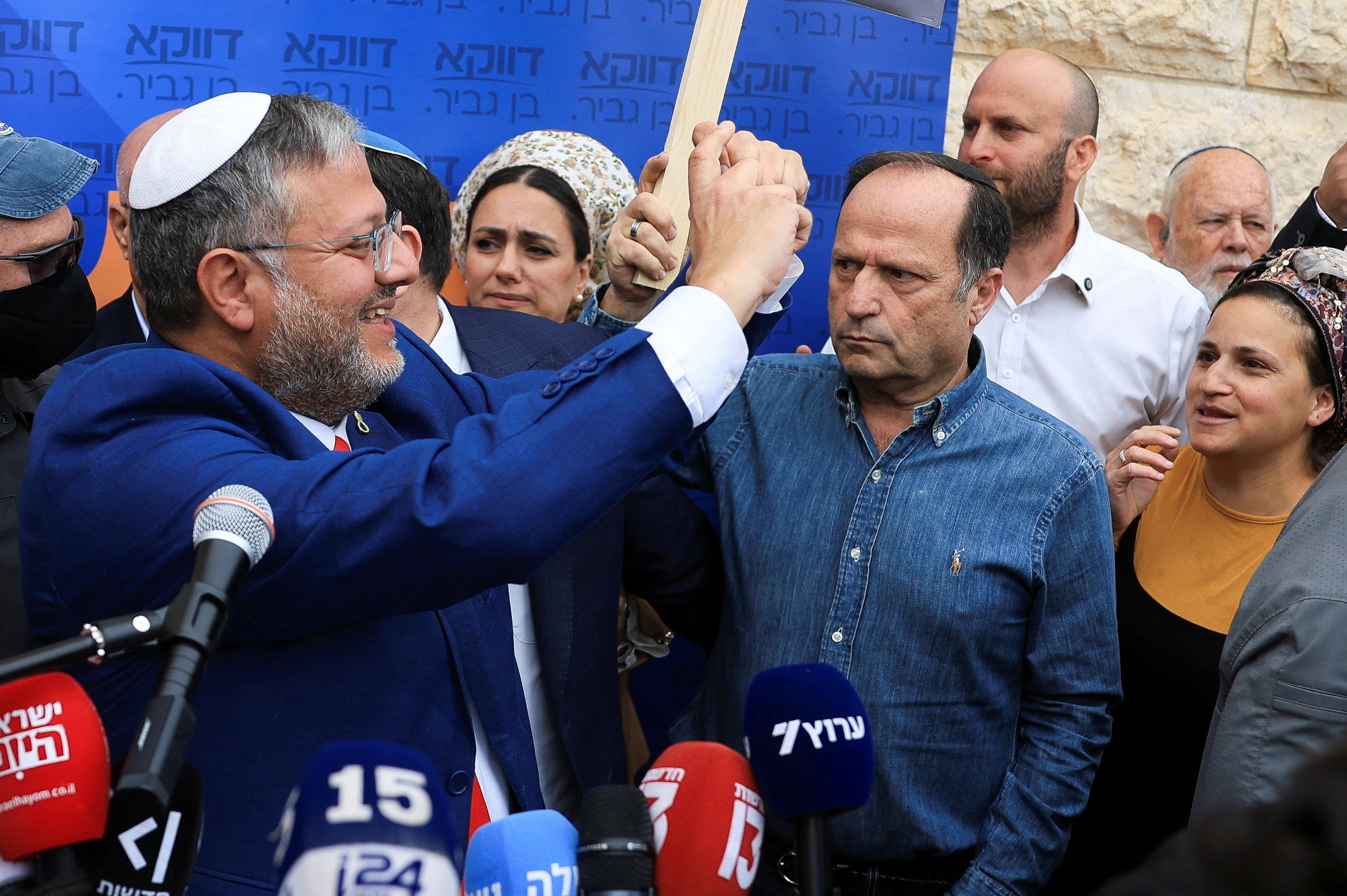
There is fury across the Jewish world at the way the extremists in the settler movement have been given free rein by security minister Itamar Ben Gvir. They have harassed and attacked Palestinian villages and burned their crops. They have an expansionist agenda and have made no secret of their desire to control all of the land in the West Bank by making life increasingly difficult for Palestinians. Horrific scenes aired on ITV this week showed school children being shot at, with one distraught teacher recalling how one teenager was shot in the head, dying in front of the school gates. We saw reports of young children waking up to barbed wire fences to stop them from getting to their primary school.
I was one of thousands of Jews from around the world to sign a letter from the London Initiative asking the Israeli president, Isaac Herzog, to intervene to stop these horrendous attacks. With an election this year, Israelis have a chance to choose a different path. The extremists pollute the early dreams of Zionism but they are not Zionism and Zionism is not them.
But diaspora Jews have no power over the Israeli government; the priorities are not seen as the same; we are seen as spoiled and not, like them, fighting an existential war on several fronts. It’s certainly true that while my son is getting drunk at university, batting off the odd anti-Zionist jibe, the sons of my friends are starting their duty in the IDF.
The roots of anti-Zionism, meanwhile, almost from the start, came from two directions. First, physically, with the Arab neighbours who have not been shy about their ambition to wipe Israel out. And, the second was from the USSR after it became clear that Israel – despite its socialist-style kibbutz movement and left-wing leadership – was not going to become a Soviet satellite, communism had a new enemy. Working on the bedrock of thousands of years of antisemitism became critical in a new movement called anti-Zionism.
The 1953 “Doctor’s plot” was an early warning. It was a show trial of prominent Moscow doctors, almost all of them Jewish, in which they were falsely blamed for the deaths of communist officials at the behest of “Zionist agents”. In November 1975, buoyed by the support of the Arab world and its satellites, the Soviet sponsored Resolution 3379 was passed at the UN, determining that Zionism is “a form of racism and racial discrimination”.
A few years later, the Soviets created a propaganda unit: The Anti-Zionist Committee of the Soviet Public. Peopled by “Zionologists”, it provided brochures, books, and newspaper articles on the evil of Israel and Zionism, often based on Nazi propaganda and older forgeries including The Protocols of the Elders of Zion. In Africa, they described Zionists as colonialists or apartheid lovers. Zionism was blamed for the Vietnam war to get into the peace movement. For antifascists, Zionists were styled as the new Nazis and in 1969 Zionists were accused of genocide in the Middle East.
Anti-Zionism was used as a potent weapon to attack America and Western values in the Cold War battle over hearts and minds. How could the West be the good guys they claimed when they were so entrenched with protecting Zionism? Izabella Tabarovsky, an academic who grew up in the Soviet Union before moving to America and then Israel, says: “What drove this campaign was the Soviets’ apparent belief that a vast Zionist conspiracy did, in fact, exist, and that this campaign aimed at undermining the Soviet Union and socialism itself.”
There is more to this than historical hatred. Palestinian nationalism and the deaths of thousands of Palestinian civilians, as well as the lived realities of extremist settler violence, are also key
The Zionologists’ claims were disseminated across the West in left-leaning publications. In 1970, for example, in the UK printed Soviet Weekly article defined Zionism as “imperialist machinery for the carrying out of neocolonialist policies and ideological subversion”.
These ideas were pushed through the UN and via social justice movements. Meanwhile, a 2001 UN anti racism conference in Durban led to mass walkouts from Western nations because there was so much anti-Zionist Jew hatred.
The communist USSR may have disintegrated some decades ago, but like seeds planted in fertile land, the poisonous ideas it sowed have taken root and sprouted. Of course, there is more to this than historical hatred. Palestinian nationalism, repeated wars in Gaza and the deaths of thousands of Palestinian civilians, as well as the lived realities of extremist settler violence, are also key. But put together, it is a potent mix. While most people who describe themselves as anti-Zionist are not expressing hatred towards Jews, but opposition to Israeli policy and Palestinian dispossession, increasingly, today, the term “Zionist” is being used in ways that spill into conspiracy theories and dehumanising rhetoric.
From the far right, who rail against the power of “ZOG” (Zionist Occupied Government) and blame Zionists for immigration, to the far left, who spread conspiracy theories about Jewish power, the word Zionism has taken on its own meaning and, in many cases, replaced the word Jew in traditional antisemitic slurs such as controlling governments and a bloodthirsty desire to kill babies.
The way Zionism has come to take an almost obsessive position within politics has led to antisemitism scholars, such as the UK’s Professor David Hirsh and American Adam Louis-Klein who created the Movement Against Antizionism, to argue that the non-hyphenated “antizionism” should be used, as they say it has nothing to do with the true meaning of Zionism. Louis-Klein believes it should now be regarded as a form of Jew hatred which is parallel but not quite the same as antisemitism.
To be clear, criticising Israel, Netanyahu, the settlers, is not antisemitism or even anti-Zionism; however, demanding that this state and only this state should be destroyed, and that Zionists deserve to be killed, is. The ironic thing is that the more people attack Zionists as evil bogeymen, the more anti-Zionism becomes interchangeable with antisemitism, the more Jews feel they need Israel to exist.