


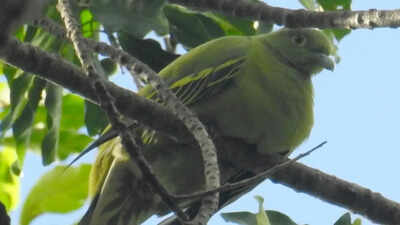
The grim news comes around the same time as the legendary British naturalist, David Attenborough, marks his 100th birthday. One of the world’s rarest birds, the Timor green pigeon, is sliding toward extinction.
What’s a Timor green pigeon?
Hidden deep in Timor-Leste’s shrinking forests, there’s a bird so rare you’d be lucky to ever hear its wings in the wild. The Timor green pigeon, with its bright green feathers, kind of like an unripe mango, is on the edge of extinction. Scientists say fewer than 500 birds might be left, and without urgent help, they could vanish in just a few years.That warning comes from a major new study in the journal Oryx, by Charles Darwin University and BirdLife International. Researchers are calling it the strongest proof yet that the Timor green pigeon’s population is rapidly collapsing in its already tiny range.It used to live across several islands in eastern Indonesia and Timor-Leste. Now, you’ll only find it in remote patches of forest in Timor-Leste’s Lautem District. Experts believe it’s “functionally extinct” in Indonesia — so few pigeons are left, real recovery looks grim unless something changes.
Timor Green Pigeon: A bird found nowhere else
Per Earth.com, the Timor green pigeon (Treron psittaceus) is found only on the island of Timor and a handful of neighboring islands. It’s not at home anywhere else in the world.It’s part of the Columbidae family, just like regular pigeons and doves, except it desperately needs tropical lowland forests and fruit trees to survive. Lots of island pigeons are at risk because they’re adapted to isolated habitats and just don’t cope well with sudden environmental changes.You’d think the bird is pretty visible thanks to its noisy wingbeats and tendency to feed out in the open in fruit trees. Ironically, that behavior makes it even easier for hunters to target them.
What caused the collapse?
The study says hunting is the number-one reason the Timor green pigeon is nearly gone. Hunters target them for meat, especially when they gather in groups at fruit trees. The problem is, when one pigeon is shot, the others stick around instead of fleeing, so hunters can kill several at a time.Losing forests only makes things worse. Over the years, forest destruction in Timor has shrunk their breeding and feeding land, leaving the remaining birds scattered and vulnerable.Dr. Colin Trainor, who led the study, has watched the crisis unfold over two decades. He remembers being able to spot the birds pretty easily in 2002, but after years of surveying, the sightings dropped dramatically.The research team logged over 1,400 survey days from 2002 to 2025 across the pigeon’s old range. Out of just 96 sightings, almost all recent ones came from a single area in Nino Konis Santana National Park. Protected lands haven’t been enough to save the birds.
Why are scientists sounding the alarm now?
The study highlights just how fast the pigeon has disappeared from its previous habitats. There used to be plenty of sightings from Indonesian West Timor before 2000, but now it’s all concentrated in Timor-Leste. Researchers have found almost no evidence of healthy populations in Indonesia lately.Official estimates used to put the global population at up to 2,000 birds, but the new research says the real number’s likely much lower — maybe only 100 to 500 left.That places the Timor green pigeon in really dire straits.Conservationists are pushing for the International Union for Conservation of Nature (IUCN) to reclassify the species as Critically Endangered, hoping it’ll draw more attention and funding.Alex Berryman from BirdLife International says this could be one of the most likely extinctions in Wallacea, which is famous for its unique biodiversity.
Is there still hope?
Despite how bad things are, the researchers think extinction isn’t inevitable — not yet, anyway. Most remaining pigeons live in one last stronghold inside protected Timor-Leste forests. Scientists say urgent cooperation between governments, conservation groups, and local communities could still pull the pigeons back from the brink.A major goal is to cut hunting through education and financial incentives for local residents. Researchers think just a small number of hunters are responsible for most of the losses.Conservationists also want better monitoring, more protected habitats, and bigger biodiversity investments in Timor-Leste, which is often overlooked in international funding.For now, the Timor green pigeon still calls out in remote forests, its wingbeats echoing through the canopy. But scientists say the clock is ticking.If action doesn’t come soon, one of Southeast Asia’s rarest birds might disappear without most people even realizing it was ever here.