


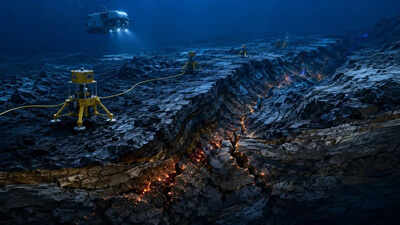
For decades, a strange patch of the Pacific Ocean has quietly puzzled earthquake scientists around the world. Deep beneath the seafloor, near the coast of Ecuador, a massive underwater fault has been producing almost identical earthquakes every five to six years. The quakes strike with nearly the same magnitude, rupture almost the same sections of the fault, and then stop. That kind of consistency is extremely unusual in earthquake science, where seismic activity is normally unpredictable and chaotic.Now, researchers believe they may finally understand why this keeps happening. Reportedly, a new study led by scientists from Indiana University Bloomington suggests the fault contains hidden “brake zones” deep underground. These natural barriers appear to slow down earthquake ruptures before they can grow into far larger and more destructive events. Experts say the discovery could change how scientists understand underwater earthquakes across the world’s oceans.
Hidden earthquake “brakes” inside the Gofar transform fault
The unusual seismic activity comes from the Gofar transform fault, located near the East Pacific Rise around 1,000 miles west of Ecuador. This underwater fault marks the boundary where the Pacific and Nazca tectonic plates slowly slide past each other.According to an Indiana University study published in ScienceDaily, titled ‘Scientists discover hidden ‘brakes’ that stop massive earthquakes’, the movement is gradual, measuring roughly 140 millimetres per year, which scientists often compare to the speed at which human fingernails grow. Even though the movement seems tiny, the pressure building beneath the Earth’s crust can eventually trigger powerful earthquakes.What made the Gofar fault especially strange was the repeating pattern of its earthquakes. Since at least the 1990s, the same sections of the fault have repeatedly produced magnitude 6 earthquakes every few years. Researchers found it difficult to explain how such a regular cycle could continue for decades without producing either much larger or much smaller earthquakes.Scientists have long known that certain quieter stretches existed between the more active earthquake zones. These sections were referred to as “barriers” because they appeared to stop ruptures from spreading further along the fault. Until now, nobody fully understood what these barriers actually were or how they worked.
Scientists placed instruments on the seafloor
To investigate the mystery, researchers from institutions including the Woods Hole Oceanographic Institution, Scripps Institution of Oceanography, and the United States Geological Survey carried out detailed seafloor experiments.Scientists deployed specialised ocean-bottom seismometers directly onto the seabed during two major missions, one in 2008 and another between 2019 and 2022. These instruments recorded tens of thousands of tiny earthquakes occurring before and after two major magnitude 6 events.The data reportedly revealed a remarkably consistent pattern. In the days and weeks before a major earthquake occurred, the quieter barrier zones suddenly experienced bursts of small seismic activity. Once the larger earthquake happened, those same regions became almost completely silent.Researchers noticed that this behaviour appeared in multiple sections of the fault over a period of more than a decade. That repeated pattern strongly suggested that the same physical process was happening each time.
The hidden “brakes” beneath the ocean floor
The new study suggests that these barrier zones are not simple inactive patches of rock. Instead, they appear to be highly fractured and complicated sections where the fault splits into several smaller strands underground.Small sideways offsets between these strands create tiny openings within the rock structure. Scientists also found evidence that seawater seeps deep into these fractured regions over time.According to researchers, this combination of unusual rock geometry and trapped fluids creates the perfect conditions for something called “dilatancy strengthening.” During a large earthquake, movement along the fault suddenly reduces pressure inside the fluid-filled rocks. As the pressure drops, the surrounding porous rock temporarily stiffens and locks up. That process effectively slows down or stops the earthquake rupture before it can continue spreading through the fault.Researchers say these zones work almost like natural brakes hidden deep inside the Earth. Lead author Jianhua Gong explained that the barriers are not passive geological features. Instead, they are active parts of the fault system that constantly influence how earthquakes behave beneath the ocean floor.