


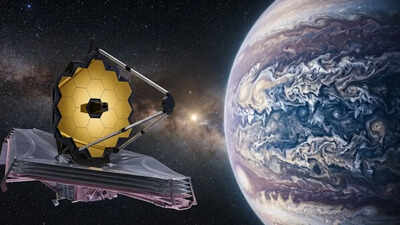
The James Webb Space Telescope recently managed to capture a direct image of Epsilon Indi Ab, a ‘Super-Jupiter’ just a dozen light-years away, marking a significant step forward in our understanding of planets outside our solar system. Using its Mid-Infrared Instrument, an international team of researchers found signs in the atmosphere that strongly suggested patchy clouds made of water ice. This discovery has begun to change how we think about cold gas giants; unlike our own Jupiter, with its ammonia-rich atmosphere, this ancient world appears to have meteorological cycles driven by water-ice, similar to Earth’s upper atmosphere. By studying how unexpectedly weak ammonia signals, scientists are starting to understand more about how giant planets’ atmospheres evolve, offering a crucial starting point for when they eventually characterise smaller, more temperate, and possibly habitable rocky planets scattered across the galaxy.
How NASA ’s James Webb Telescope captured a hidden giant planet
According to NASA Science, the James Webb Space Telescope needed to use a specialised coronagraph built into its MIRI instrument. This device allowed it to block out the bright light from the host star, Epsilon Indi A, making it possible to directly capture the planet’s own heat radiation. Epsilon Indi Ab is quite large, possessing a precisely measured mass of 7.6 times the mass of Jupiter, which makes it one of the most massive cold exoplanets we have ever observed. The information gathered revealed that the planet exhibited significant absorption at shorter wavelengths than what theoretical models had predicted, a phenomenon the researchers believe comes from high-altitude, patchy clouds scattering the light.
Why Epsilon Indi Ab is a record-breaking ‘cold’ world
With its estimated effective temperature ranging from 200 to 300 Kelvin, placing it near the freezing point of water, Epsilon Indi Ab is almost a hundred degrees Celsius colder than any other gas giant that has been imaged directly before. At these kinds of temperatures, the atmosphere begins to change; instead of being dominated by methane and ammonia, it starts to allow for the formation of water-ice crystals. This effectively makes the planet a ‘Jupiter-analogue’ that bridges the gap between the scorching hot gas giants found in distant star systems and the frigid giants within our own solar system, giving us a unique glimpse into how water cycles operate on worlds with immense gravity.
Direct imaging unlocks cold exoplanets
Most exoplanets are studied through transits, which occur when they move in front of their stars. However, Epsilon Indi Ab was discovered using direct imaging. This technique poses challenges because planets appear millions of times dimmer than their stars. As noted in ESA/Webb, the discovery of Epsilon Indi Ab holds importance as the planet is a mature, ‘middle-aged’ world with an age of approximately 3.5 billion years, indicating significant cooling over time. Studying such a mature and cold planet allows astronomers to improve evolutionary models predicting planetary changes across billions of years.
Why current atmospheric models are wrong
Research published in The Astrophysical Journal Letters highlights that the apparent lack of methane and ammonia suggests high atmospheric metallicity, a large presence of elements heavier than hydrogen and helium. Heavy elements within the atmosphere might cause dense clouds to form or increase light absorption. This observation strongly contradicts current 1D atmospheric simulations and implies that ‘Super-Jupiters’ could possess more complex chemical compositions than previously thought.