


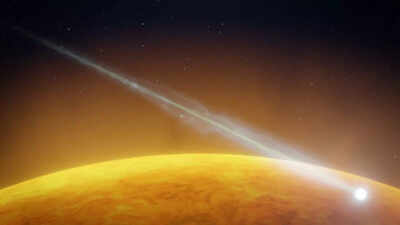
The sky could host a brief but remarkable event in early April 2026. Astronomers are closely tracking a newly discovered sungrazing comet, officially named C/2026 A1 MAPS. As reported by Universe Today, it was first observed in January by a team operating telescopes in Chile’s Atacama Desert. What makes this comet notable is not just its trajectory, but the conditions it will face. It is set to pass extremely close to the Sun, a region where many comets do not survive. Current data suggest that, if it remains intact after this passage, it could be visible from Earth for a short time. The outcome is uncertain, but the observations leading up to April are already providing valuable scientific insights.
C/2026 A1 MAPS comet heads closest to the Sun on April 4: Time and distance
The comet is predicted to reach perihelion, its closest point to the Sun, on 4 April 2026. Current orbital solutions place this distance at about 1.18 solar radii from the Sun’s centre. In practical terms, this is roughly 160,000 kilometres above the Sun’s visible surface at 9:13 am EDT as reported by Sky and Telescope.This trajectory places the comet well within the solar corona, the outermost layer of the Sun’s atmosphere. Conditions in this region include extremely high temperatures and intense radiation. These factors significantly increase the likelihood of structural disruption. Many sungrazing comets fragment or completely disintegrate during this phase due to thermal stress and tidal forces.
C/2026 A1 MAPS discovery and early observations
As reported, C/2026 A1 MAPS was detected on 13 January 2026 and initially given a provisional designation before receiving its official name. The acronym “MAPS” comes from the surnames of its discoverers: Alain Maury, Georges Attard, Daniel Parrott, and Florian Signoret.At the time of discovery, the comet was located approximately 2.056 astronomical units from the Sun, equivalent to about 307 million kilometres. This is considered a large distance for identifying a sungrazing comet. Its brightness was measured at magnitude +17.8, indicating it was faint but detectable with advanced telescopes.
C/2026 A1 MAPS and its comet group origins
C/2026 A1 MAPS belongs to the Kreutz group of sungrazing comets. This family is believed to have originated from the fragmentation of a much larger parent comet, observed as early as 362 BC. Subsequent breakups have produced numerous smaller comets that follow similar orbits bringing them very close to the Sun. Historically, several bright comets have been associated with this group. These include the Great Comets of 1843 and 1882, as well as C/1965 Ikeya–Seki, which became highly visible during its perihelion passage.The Kreutz group is also known for a high rate of disintegration, with only a small number of members surviving their solar encounter.
C/2026 A1 MAPS visibility from Earth
As reported by Universe Today, before reaching perihelion, C/2026 A1 MAPS is expected to move through the constellations Fornax, Eridanus, Cetus, and Pisces. During late March, its brightness may improve to around magnitude +10, making it potentially observable with small telescopes under suitable conditions.The comet approaches from the southern celestial hemisphere, which limits visibility for observers in northern regions. Its position will remain low in the sky, particularly during twilight hours. After perihelion, if the comet remains intact, it may reappear briefly in the evening sky. Some projections suggest it could brighten significantly, though such estimates depend heavily on its survival.
C/2026 A1 MAPS and space-based observations
Due to the comet’s proximity to the Sun, ground-based observation will be difficult during its closest approach. Space-based instruments provide the most reliable method of tracking it during this period. The Solar and Heliospheric Observatory (SOHO), a joint mission by NASA and ESA, is expected to capture the comet as it enters the field of view of its LASCO instruments. It is projected to appear in the LASCO C3 camera on 2 April and move into the narrower C2 field on 4 April, according to Sky and Telescope.