



NEW DELHI: The Supreme Court on Wednesday came down hard on West Bengal CM Mamata Banerjee for interfering with Enforcement Directorate searches on Indian Political Action Committee (I-PAC), the political consultancy hired by the state government and Trinamool Congress, and said that her action had put democracy in peril.Justices Prashant Kumar Mishra and N V Anjaria rejected the efforts of the heavy-duty team of Banerjee’s lawyers to frame the issue as that of Centre-State.“This is not a dispute between the State and the Union. A chief minister of any State cannot walk in the midst of an investigation, put democracy in peril… don’t convert this into a dispute between the State and the Union. This is, per se, an act committed by an individual who happens to be the chief minister, keeping the whole democracy in jeopardy,” the bench said.The tough remarks, on the eve of polling for Bengal Phase 1 polls, mark a setback for Banerjee, while giving the BJP, her principal opponent, ammunition.
How can it be a Centre-state row if CM walks in in midst of probe: SC
Banerjee, accompanied by the Bengal DGP, had on Jan 8 interrupted ED’s searches at the residence of Pratik Jain, I-PAC’s director, and had walked away with files which the ED claimed were crucial for its investigation into the political consultancy’s alleged involvement in money laundering.The ED moved SC alleging that Mamata Banerjee’s action violated its fundamental rights and sought relief under Article 32, which deals with protection from violation of fundamental rights.
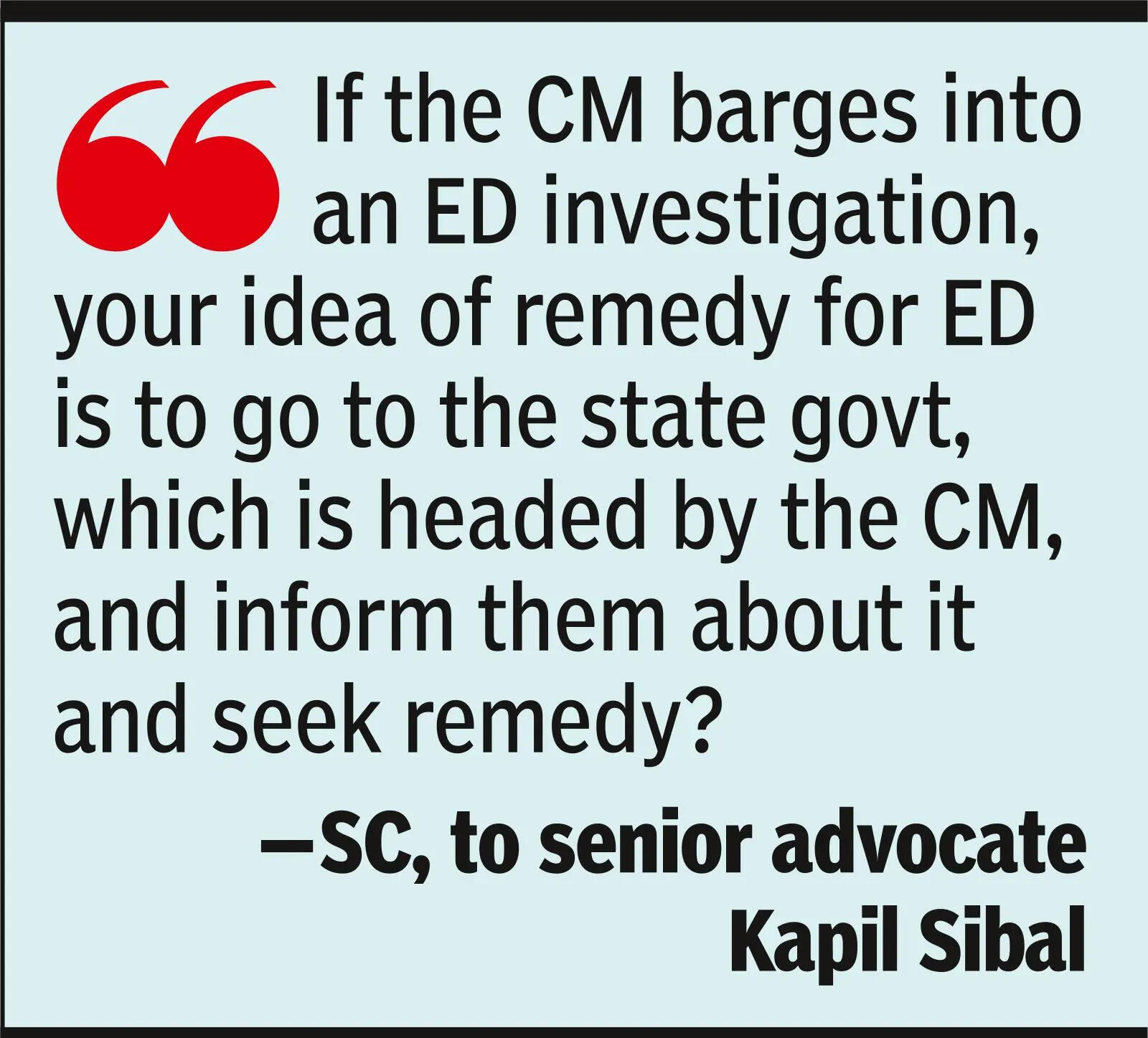
Banerjee, represented by a battery of lawyers — Kapil Sibal, AM Singhvi, Shyam Divan, Siddharth Luthra and Menaka Guruswamy — argued that remedies provided for under Article 32 are available only to individual citizens and that the ED should pursue its case under provisions of the BNS. They said it was for the Centre to move the court under Article 131, which deals with disputes between the Centre and state(s).However, the bench, which termed her conduct “extraordinary and unprecedented”, did not agree. “How can a situation, where a CM walks in in the midst of an investigation, be termed as a dispute between the state and the central govt to invoke Article 131,” asked Justices Mishra and Anjaria.The court said legal issues arising out of the present controversy were not contemplated and conceived by the Constitution makers, making it an unprecedented situation.Guruswamy, besides contending that Article 32 is available only to an individual and not to a govt department, argued that the case involved a substantial question of law and it should be adjudicated by a 5-judge constitution bench.The bench was hearing a plea filed by the ED and its officials seeking a CBI probe against the CM and others for preventing them from discharging their duty when they had raided the premises of I-PAC, which is the political consultant of Trinamool.