


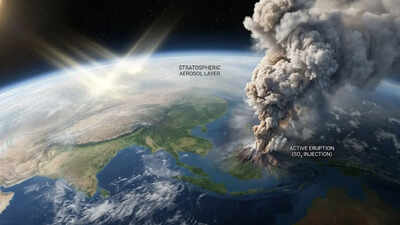
The cooling effect that volcanoes can have on the environment is often underestimated. Volcanic eruptions produce high-temperature lava and can severely damage the surrounding area, but they may also introduce a large amount of sulfur dioxide gas into the atmosphere due to a massive volume of volatiles and tephra propelled into the atmosphere from the volcano. In particular, the sulfur dioxide enters the upper atmosphere (stratosphere) and undergoes transformation into extremely small, liquid droplets of sulfuric acid, which effectively increase the Earth’s albedo, acting as a stratospheric mirror.These tiny sulfuric acid droplets reflect the sun’s energy to outer space, and this solar reflection results in an overall reduction in the surface temperature of the Earth for many years as a result of the parasol effect. Examples of these long-lasting cooling effects can be seen throughout the history of our planet in volcanic events such as the eruption of Mount Pinatubo in 1991, because that eruption taught scientists about the importance of understanding how natural aerosols help to maintain the complex thermal balance of the Earth.
Volcanoes can chill the Earth
The injection of large quantities of sulfur dioxide into the atmosphere during an explosive volcanic eruption acts as the main cause of global cooling. Since volcanic ash is much heavier than sulfur dioxide and will quickly settle to the ground in a matter of days or weeks, it does not have the same long-term impact on the climate as does the sulfur dioxide.Once the sulfur dioxide is injected into the atmosphere, it reacts with the water vapour to produce very small particles of sulfuric acid (microscale size) in the form of aerosols. These aerosols can remain suspended in the atmosphere for several years and form a layer of haze that causes the surface of the Earth to be more reflective to incoming solar radiation. By reflecting and refracting the incoming solar radiation through the layer of aerosol, the aerosols will cause a measurable decrease in the average global temperature.
How 20 million tons of gas cooled the planet
The 1991 eruption of Mount Pinatubo in the Philippines greatly improved scientists’ understanding of how volcanic eruptions and atmospheric matters interact. The stratospheric injection of approximately 15–20 million tons of sulfur dioxide into the stratosphere, which spread around the world, created an effective blocking agent for solar radiation. The average global temperature decreased by approximately 0.5 degrees Celsius from 1992 to 1993, as noted by NASA Earth Observatory. Researchers use this case to illustrate how volcanoes affect climate and how scientists use satellite data to quantify the amount of solar energy blocked by volcanic activity.
Lessons from the Tambora eruption
The eruption of Mount Tambora in Indonesia in April of 1815 represents the most dramatic example of volcanic cooling in the history of the planet. The amount of aerosols produced during this eruption was sufficient to create ‘volcanic winter’ conditions all over the world, which led to the ‘Year Without a Summer’ in the Northern Hemisphere in 1816, as noted in the National Oceanic and Atmospheric Administration (NOAA). The climate shifted dramatically in the Northern Hemisphere during this time as well, with frost and even snow occurring in July in New England and rain falling in Europe as ice. The resulting drop in temperature caused crop failure and the death of livestock throughout North America and Europe; therefore, while this effect of cooling is scientifically interesting, it also has devastating effects on human civilisation and agriculture.
Why volcanic cooling cannot offset greenhouse warming
It is important to be able to determine the effect that volcanoes have on the Earth’s temperature in comparison to the Earth’s temperature due to human activity. Volcanoes do produce carbon dioxide; however, the amount of carbon dioxide produced is much less than that due to the emissions of humans and their activities. This is apparent when comparing the tons of carbon dioxide emitted by volcanoes with the amount of carbon dioxide emitted by man-made sources in just a few days. According to a study published on Climate, annual emissions of carbon dioxide from the world’s volcanoes total 0.13-0.44 gigatons carbon dioxide, whereas annual industrial carbon dioxide emissions from humans are significantly greater than those from volcanoes, and are emitted over a period of a few days to weeks. Additionally, the cooling effect of sulfate aerosol emissions from volcanoes lasts for only 1-3 years (on average) before they are returned to the lower atmosphere through precipitation, so those cooling effects will not offset the long-term warming of the planet due to the buildup of greenhouse gas emissions in the atmosphere.