


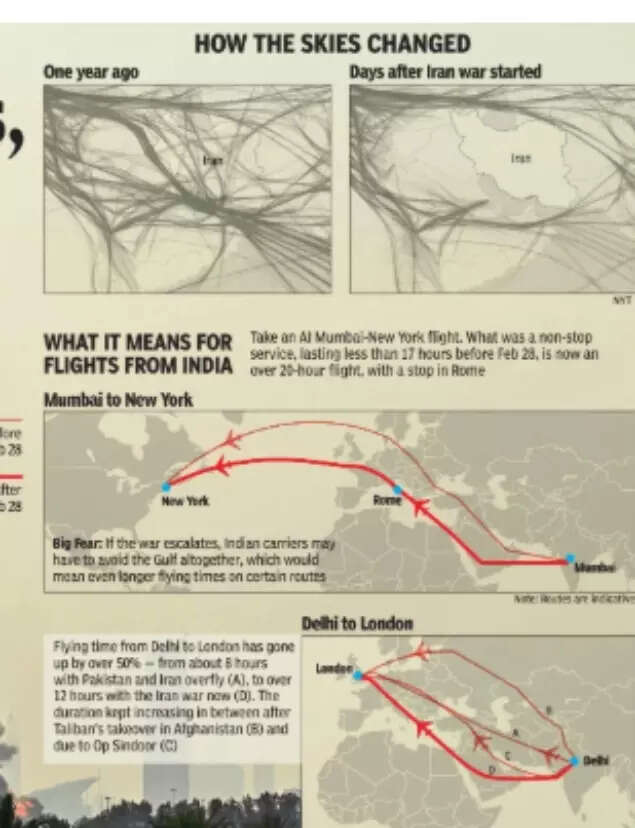
Passengers seated to the (right or left) can see the pyramids of Giza.” Fatigued pilots of Air India operating flights to and from the West now often make this announcement on clear visibility days while overflying Egypt on the excruciatingly longer routes imposed by the US-Israel war against Iran.Since Feb 28, going west — except to the west coast of North America — from India means overflying Arabian Sea while steering clear of Pakistan (for Indian carriers) and Iranian airspace (for all); then turning right from over Oman en route to Muscat, Saudi Arabia or beyond, via Cairo, to Europe, UK and North America. It’s the same route on the way back. The war-zone air traffic corridor covering the airspaces of Afghanistan (starting with Pakistan for Indian carriers), Iran, Iraq, Lebanon, Jordan, Israel bears a deserted look with almost all planes flying below this passage. The usable corridors in the region, like parts of Saudi Arabia, are seeing the war affect them, too.The impact: Air India Delhi-London non-stop flying time has increased 50% from about eight hours — when both Pakistan (for Indian carriers) and Afghanistan airspace used to be open — to over 12 hours now after the Iran war. Its Mumbai-New York 13-14-hour non-stop has become a onestop via Rome with the travel time close to 21 hours now. IndiGo uses wide body aircraft of Norway’s Norse Atlantic airline, which completely bypass West Asia per the EU regulator’s advice. They fly over the Arabian Sea right up to Africa, and then turn right to fly north to Cairo and beyond. Same route on return for all.Since Feb 28, the Iran war has led to passengers facing a sharp rise in airfares and drastic fall in travel options with the Big Three — Emirates, Qatar Airways, and Etihad — out of the picture for now. Airlines have seen their operating costs skyrocket, fewer lucrative Gulf flights, and fatigued pilots at the controls of their widebody aircraft. Here’s how it is impacting different stakeholders:
Indian operatorsShrunk Network: They used to have between 400 and 500 daily flights between India and the West, a number that has sharply fallen since Feb 28 due to the closure of airports in Bahrain and Doha, even as those in UAE stay sporadically open and offer slots. Only a few places, like parts of Saudi, and Muscat, have regular flights and overflying these days in the region.Half of IndiGo’s 300 daily international flights were to the West and that has shrunk to a handful now. Air India Express had 110 daily West Asia connections, which is now down to 50 “ad hoc” connections. Air India had 254 scheduled weekly West Asia flights and that’s dropped to 30-40. Akasa and SpiceJet have also seen a reduction in their Gulf flights.Escalating operating costs: Since the Iran war began, aviation turbine fuel (ATF) prices have effectively risen every time the rupee hits a new low, which is a daily feature now. It currently costs about $817 per kilo litre (kL) in both Delhi and Mumbai — up from about $779 last month. But the INR-to-USD exchange rate has gone from Rs 91 to Rs 93.30. So have all dollar-denominated costs — like lease rentals and maintenance — escalated.To top it all, routes have got much longer, which means burning much more of that costly fuel. A Boeing 787 burns about five tonnes of fuel every hour and a B777 about 7.5 tonnes. If flying time goes up by two hours, there’s an extra 10-15 tonnes burnt per flight. At $817 per tonne for international flights of domestic carriers, and the rupee at 93.30 to a dollar, the extra expense on fuel alone works out to Rs 80,000 per hour. Air India has 358 weekly flights to the West — covering Europe, UK and North America — which are still operating.Indian operators upload much more fuel than usual from India these days so that aircraft can return home with passengers — instead of getting stuck — in case of escalated fighting in West Asia. More fuel means a heavier plane. And heavier the plane, more is the fuel burn.“At current operating costs, it does not make sense to operate the West flights. We are doing so as a commitment to keep our flyers connected. Flying aircraft has always meant defying nature, with heavy metal tubes kept airborne. Now, after the Iran war, they are defying economics, too,” said a senior official. Airlines’ pleas to govt for some relief on ATF excise or VAT have been futile so far.The impact is staggering for all, more so the Maharaja. The AI Group, IndiGo and Akasa have imposed a fuel surcharge, ranging from Rs 199 to $200, on their flights. Insurance costs for flights to West Asia have soared by as much as Rs 30-40 lakh for a narrow-body return trip and Rs 90 lakh to Rs 1 crore for a wide-body round trip.Fatigued crewWith aircraft flying much longer routes to and from the West, Air India sought — and got — exemption from flight duty time limitation rules for its crew from the Directorate General of Civil Aviation (DGCA). The regulator has now allowed its pilots to fly up to 11.5 hours, which means two pilots can operate longer flights without the need for a third one that would allow them to rest in turn en route. Pilots have been flying the longer routes from last April itself, when Pakistan airspace was closed during Operation Sindoor. The Iran war has further stretched the already long routes.AI’s Boeing 787 Dreamliner pilots are worst hit as that aircraft’s cockpit seat allows limited recline due to a safety issue. “We are pushing our body to the limit of human endurance,” is what a B787 pilot had to say, a sentiment echoed by others. “Imagine sitting in an uncomfortable office chair for 11.5 hours straight and being present 100% for the entire duration as we are flying close to a war zone with GPS jamming and spoofing all the way from the airspaces close to Pakistan to beyond Turkey. Airlines should be asked to increase pilot availability. God forbid, if something goes wrong, just blame the pilot. That’s the usual script.”Both AI and DGCA are aware of the difficulties, which they blame on extraordinary circumstances. AI has converted 30 B777 pilots to the Dreamliner and they are expected to start flying in two months.“We have formally sought coordinated flight time (FT) and flight duty period (FDP) exemptions from DGCA. These ex-emptions are intended to be used only till the current Middle East airspace restrictions are in effect and are critical for maintaining schedule integrity and minimise passenger inconvenience… All such exemptions are supported by safety risk assessments and will be applied strictly in accordance with approved conditions,” AI senior VP (flight ops), Capt Manish Uppal, said in a mail recently to pilots.Turbulence hits passengersWhen the Iran war broke out, passengers were forced to shell out enormous amounts to fly to their destinations, and India was no exception. An Indian student, who had come to Delhi from Ireland in mid Feb for his grandfather’s last rites, paid Rs 1.8 lakh for a one-way ticket to return to college.Many people are holding on to their bookings on Emirates, Etihad, Qatar Airways for this summer. If the war does not end quickly and those airlines don’t restore flights soon thereafter, airfares on other options will defy gravity in the approaching summer travel months that begin from early April in India.Adding capacityGulf carriers have historically carried a significant chunk of traffic between India and the rest of the world via their mega hubs like Dubai, Doha, and Abu Dhabi. The sudden unavailability of the Big Three has created a vacuum, with passengers who’d already booked on them for travel post Feb 28 now looking for alternatives and, thus, chasing the same limited options as those making fresh bookings.Air India is adding as many extra flights to the West as possible. Lufthansa deployed its 500-seater Airbus A380 instead of the 280-seater A350 on Munich-Delhi and Munich-Mumbai routes apart from increasing frequency between Chennai and Frankfurt. SWISS will operate a second daily service between Delhi and Zurich during March 19-24. Lufthansa is weighing the option of getting more group airlines to India. Only Lufthansa, SWISS and ITA now fly to India; there are other group carriers that do not as of now, including Austrian, Brussels Airlines, Discover, and Eurowings.Away from flights, some ways in which war’s hurting India…Medical devices : Rising medical-grade plastic, freight and gas costs are threatening medical supplies like syringes, hospital disposables. Prolonged disruption could trigger production cuts and price hikesPharma: Shortage of propane has led to shutdowns at drug plants across states. Output of some essential medicines hitFertilisers: LNG disruption is affecting ammonia and urea production ahead of kharif seasonRestaurants/catering: Commercial LPG shortages are pushing up costs and disrupting operationsACs: LPG and petrochemical shortages are hurting air-conditioner production just before the summer seasonAutomobiles: Costlier components, gas shortages are straining auto production