


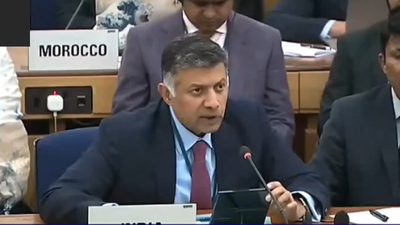
India has condemned attacks on commercial shipping in the Strait of Hormuz, calling them “unacceptable,” as the International Maritime Organization (IMO) urged coordinated action to safeguard civilian vessels in the Gulf region.Addressing the 36th extraordinary session of the IMO Council in London on Thursday, Vikram Doraiswamy, India’s ambassador to the UK, emphasised New Delhi’s commitment to maritime security, freedom of navigation, and the safety of all seafarers.“India remains deeply concerned about the evolving situation and continues to call for de-escalation through dialogue and diplomacy, with utmost restraint and priority being given to the safety of civilians,” he said.Condoling the loss of innocent lives, including three Indian seafarers, Doraiswamy asserted that attacks on commercial shipping and civilian maritime infrastructure endanger lives and are unacceptable. “Targeting of commercial shipping and attacks on civilian maritime infrastructure is unacceptable. Such attacks have resulted in the loss of innocent lives, injuries, and heightened risks, including to seafarers. India is among the top three seafarer-supplying nations, contributing approximately 13 per cent of the global seafaring workforce. We remain deeply concerned about the safety and welfare of all seafarers,” Doraiswamy added. He also noted India’s 24×7 helpline for affected seafarers and the role of the Information Fusion Centre, Indian Ocean Region (IFC-IOR), hosted by the Indian Navy, in coordinating rescue efforts and sharing information. He added, “We reiterate that targeting commercial shipping, endangering civilian crews, and impeding safe and free navigation through international waterways, including the Strait of Hormuz, are unacceptable. The exercise of navigational rights and freedom by merchant and commercial vessels in accordance with international law must be respected.”The ambassador went on to say, “At present, 24 Indian flagged vessels are operating the Persian Gulf region, including 22 vessels west of the Strait of Hormuz with 611 Indian seafarers on board and two vessels east of the Strait of Hormuz, with 47 seafarers on board” Further he reflected on the critical importance of Strait of Hormuz for the country saying, “ India’s energy, security and trade are critically dependent on the safe and unimpeded passage through the Strait of Hormuz. Any disruption, obstruction or closures of these vital waterways have direct consequences for India’s economy and for global energy and humanitarian supply chains.”The IMO Council condemned threats and attacks on merchant vessels, including attempts to close the Strait of Hormuz, citing UN Security Council Resolution 2817. The Council adopted a decision encouraging the establishment of a maritime safety corridor to facilitate voluntary evacuation of ships from high-risk areas. It called for an internationally coordinated approach to maritime security and urged member states to ensure continuous provision of essential supplies, water, food, and fuel, to ships unable to leave the region.IMO secretary-general went on to emphasise the need for decisive action, saying, “Let it be the responsibility of each and every one of us to demonstrate that inaction is not an option, that words alone are not sufficient. Together, we can drive the change required to protect the wellbeing of those who have no voice and safeguard the principle of freedom of navigation.”The session was attended by more than 120 member states, including all 40 Council members. The Middle East conflict has heavily affected shipping through the Strait of Hormuz. Currently, 24 Indian-flagged vessels are operating in the Persian Gulf, with 611 Indian seafarers west of the Strait and 47 east of it.This session follows growing international concern over maritime safety as attacks in the Gulf threaten both trade and energy supply chains.