


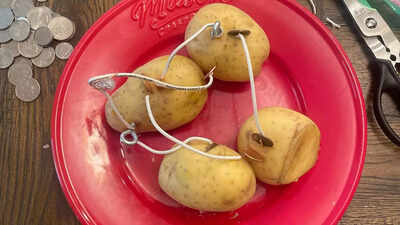
The discovery that an ordinary potato can become an effective energy source after a little tweaking was made by researchers at The Hebrew University of Jerusalem, who conducted a study published in Smithsonian Magazine. After boiling a potato for eight minutes, they were able to cause cell membrane ruptures within the potato’s internal structure, which reduced the internal resistance of the potato to electrical current flow, thus increasing the amount of electricity produced by the potato to ten times its initial amount. This type of potato battery (green battery) will power an LED light for over a month and costs six times less than using kerosene for lighting. Thus, off-grid communities could have a sustainable and renewable source of electric power through the use of a common vegetable.
How current forms in a potato
Potatoes do not contain electricity in them; they serve as salt bridges that enable chemical reactions to occur. When you place a zinc-coated nail (the anode) and a copper coin (the cathode) into the potato, a redox (reduction-oxidation) reaction happens. The zinc interacts with the potato’s phosphoric acid and releases electrons, which travel through the wires to the copper. This flow of electrons creates the necessary current to turn on an LED light bulb or power a digital clock.
Can it really last a month
The short answer is yes, but with some caveats. A whole potato has a very low voltage output (~0.5 V to 0.9 V). To light up a room using a potato, you would need to connect several boiled potato slices together in series to achieve an adequate supply of voltage for the room. If set up correctly, a ‘veggie circuit’ could power a low-energy bulb for longer than 30 days if there was enough voltage supplied and no decomposition of potatoes occurred; however, researchers found that dried-out potatoes would still serve as effective electrolytes until they completely decomposed.
Fifty times cheaper than AA batteries
The purpose of the research was to find a ‘Green Battery’ for the 1.2 billion individuals who do not have access to electricity from a power grid. The research findings indicate that treated potato batteries cost approximately fifty times less than conventional 1.5-volt AA or D-cell batteries. Additionally, when compared to kerosene lamps, which are often utilised in places that are not developed, potato batteries are six times less expensive and much safer because they offer a flicker-free light for reading or providing medical assistance and do not produce fire hazards or harmful gases.