


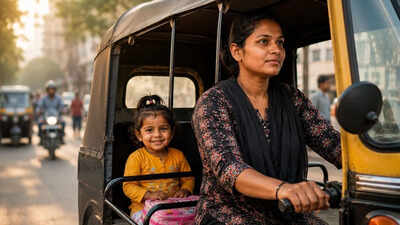
At 6:30 every morning, while most of the city is still stretching awake, a small autorickshaw quietly rolls out onto the roads of Kalyan. Sitting beside the driver is a three-year-old girl, still sleepy, clutching her breakfast box. Behind the wheel is her mother, 25-year-old Komal Dyandew Gaikwad, who has turned heartbreak into survival and survival into hope.Komal’s story does not begin with big opportunities or support. It begins with loss, uncertainty, and the kind of silence that follows when someone walks away and never returns. Yet somewhere between unpaid bills, long roads, and sleepless nights, she built a life that now moves forward on three wheels and one powerful promise, her daughter will never have to stop studying because of circumstances.
A life that changed far too early
Komal was only 18 when she got married and moved from Parbhani to the city. Like many young women, she quietly left behind her own education after Class 10 and stepped into responsibilities that arrived too quickly. By 22, she had become a mother to her daughter, Tejaswi.Then life shifted without warning.Her husband left and never came back. Suddenly, Komal found herself alone with a one-year-old child, no stable income, and days when even food became uncertain. The future looked frighteningly small.But what stands out in her story is not the abandonment. It is the decision she made after it.Instead of surrendering to helplessness, Komal chose movement. She chose work. She chose dignity.
The skill that unexpectedly became her lifeline
Before leaving, her husband had taught her how to drive an autorickshaw. At the time, it was meant to be a practical lesson — something useful for family errands or school pickups in the future.Komal never imagined that one skill would one day become the reason her daughter could eat.When no one agreed to hire her as domestic help because she had a small child, she saw only one option left: the road. She rented a rickshaw and started driving through Kalyan, Dombivli, and Thakurli, learning not just traffic routes, but also how to survive in a city that rarely slows down for anyone.There is something deeply human about the way her story unfolds. It is not dramatic in the cinematic sense. There are no overnight miracles. Only long hours, difficult decisions, and a woman trying to keep life steady for her child.
The little seat beside the driver tells the real story
Komal’s biggest challenge was never the traffic. It was motherhood.With nobody available to care for Tejaswi, she had to find a way to keep her daughter close while working. So she saved every rupee she could, arranged a loan, paid a down payment of Rs 60,000, and bought her own autorickshaw.Inside it, she created a small seat next to the driver’s chair just for her daughter.That tiny seat says more about sacrifice than long speeches ever could.Every day, Tejaswi travels beside her mother as the rickshaw moves through crowded roads and noisy signals. Her breakfast is packed early in the morning. Her mother drives until noon, returns home to cook, and heads back to work by 4 pm. The day ends only around 10 pm.There are no Sundays off. No luxury of exhaustion. If Komal stops for even a day, the next day’s meals become uncertain.Yet she continues.
Earning little, carrying a lot
Despite working close to 16 hours a day, Komal earns only around Rs 400 to Rs 500 daily. From that, she pays rent for her home in Kalyan East and a monthly EMI for her rickshaw.The numbers feel harsh when placed beside the amount of effort she puts in.But what makes her journey remarkable is the absence of bitterness. There is tiredness in her voice, but not defeat. Even now, her focus remains fixed on one thing, education.Recently, she enrolled Tejaswi in a local school. For many families, school admission may look ordinary. For Komal, it is proof that the struggle is slowly turning into something meaningful.Her dream is simple but powerful. She wants her daughter to become an IPS officer.Perhaps that dream comes from knowing exactly what it feels like when women are left without power, support, or choices.
Why Komal’s story stays with people
In cities, stories like Komal’s often pass unnoticed. Thousands of people may sit in her rickshaw without fully knowing the journey of the woman driving them home.But her life reflects something important about everyday courage. Real resilience is rarely loud. Sometimes it looks like a mother waking up before sunrise, packing breakfast for her child, and driving across crowded streets so her daughter can have a future she herself never received.There is no grand stage around her. No spotlight. Only a moving autorickshaw carrying a mother, a child, and a dream that refuses to break.And perhaps that is exactly why her story feels unforgettable.Disclaimer: This article is based on publicly available reports and statements shared in media coverage. The intention is to highlight an inspiring human-interest story centred on resilience, motherhood, and determination.