



May 7 marks the first anniversary of Operation Sindoor, a military operation that has since fundamentally reshaped India’s defence priorities, and overhauled its security apparatus through a massive surge in high-tech procurement and strategic realignments.Launched in direct retaliation for the Pahalgam terror attack that claimed 26 lives, the multi-domain mission has transitioned from a singular military strike into a “whole-of-government” doctrine focused on artificial intelligence, unmanned systems, and long-range deterrence to prevent future cross-border provocations.What was once largely framed as a question of equipment upgrades and periodic budget increases is now being treated as a structural shift: A long-term push to build military power, strengthen domestic industry and reduce dependence on foreign suppliers.
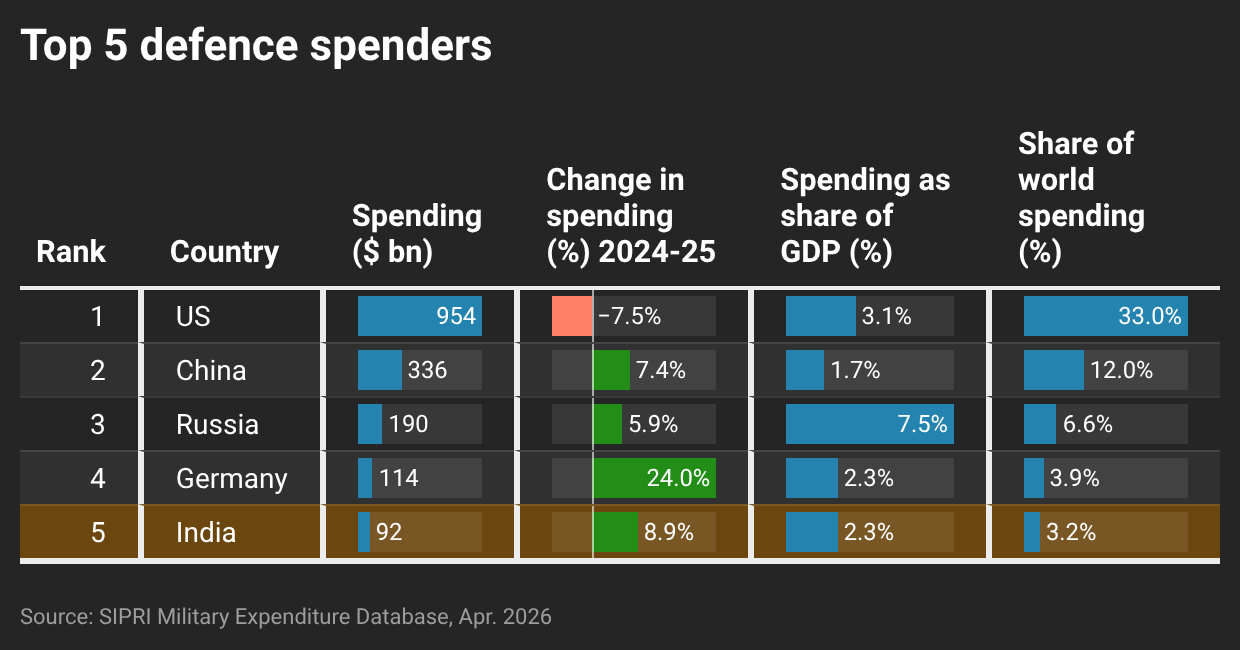
Unprecedented military expansion
In the twelve months following the hostilities, the government has greenlit a series of mega-procurement projects to ensure combat readiness. Just two months ago, in March 2026, authorities cleared military hardware acquisitions worth Rs 2.38 lakh crore.Key milestones in this strategic build-up include:
- The February approval to procure 114 Rafale fighter jets from France, equipped with Meteor beyond-visual-range missiles and Scalp cruise missiles.
- The commissioning of INS Aridaman in April, India’s third indigenously-built nuclear-powered ballistic missile submarine, which significantly strengthens the nation’s nuclear triad.
- The successful test-firing of the Agni-5 intermediate-range ballistic missile, capable of striking targets up to 5,000 km away, bringing vast swathes of Asia and parts of Europe within range.
- A fresh batch of five S-400 missile systems from Russia to bolster the national air defence grid.
Shift to tech-centric warfare
The legacy of Operation Sindoor lies in its “paradigm shift” toward digital and autonomous warfare. The three services have spent the last year integrating artificial intelligence into target analysis and acquisition.“Definitely, lessons learned from Operation Sindoor are being implemented,” said a senior military official.The focus has moved decisively toward acquiring a variety of long and short-range drones and 60 medium transport aircraft to ensure rapid deployment capabilities.Naval surveillance has also been prioritised with the purchase of 6 US-made Boeing P8-I aircraft for anti-submarine warfare.
A post-Sindoor rethink
As per a report by Morgan Stanley, the change is visible in policy, procurement and spending priorities.Defence outlays are no longer being justified only as a response to a difficult security environment. They are increasingly being used as an instrument of industrial policy, with the government explicitly linking military modernisation to indigenisation, advanced manufacturing and supply-chain depth.Operation Sindoor reinforced a lesson already forming in New Delhi: India cannot rely on cyclical defence spending or imported systems alone if it wants lasting strategic autonomy.The conflict environment around India, from the western front to the wider Indo-Pacific, has made military preparedness a permanent requirement rather than a short-term surge.That has sharpened the focus on resilience and self-reliance.India’s defence strategy is now less about simply buying more weapons and more about ensuring that the country can design, produce, maintain and upgrade critical platforms at home.The emphasis is shifting from procurement to capability-building.This is not just a military adjustment. It is a broader strategic decision that links national security to domestic industrial capacity.
Structural spending
The clearest sign of the change is in the budget trajectory.India aims to raise defence spending from average 2% of GDP to 2.5% by FY2031, according to the government’s stated direction. In FY2027, the Union Budget has pegged defence capex at about ₹22 lakh crore, up 18% from FY2026 revised estimates.
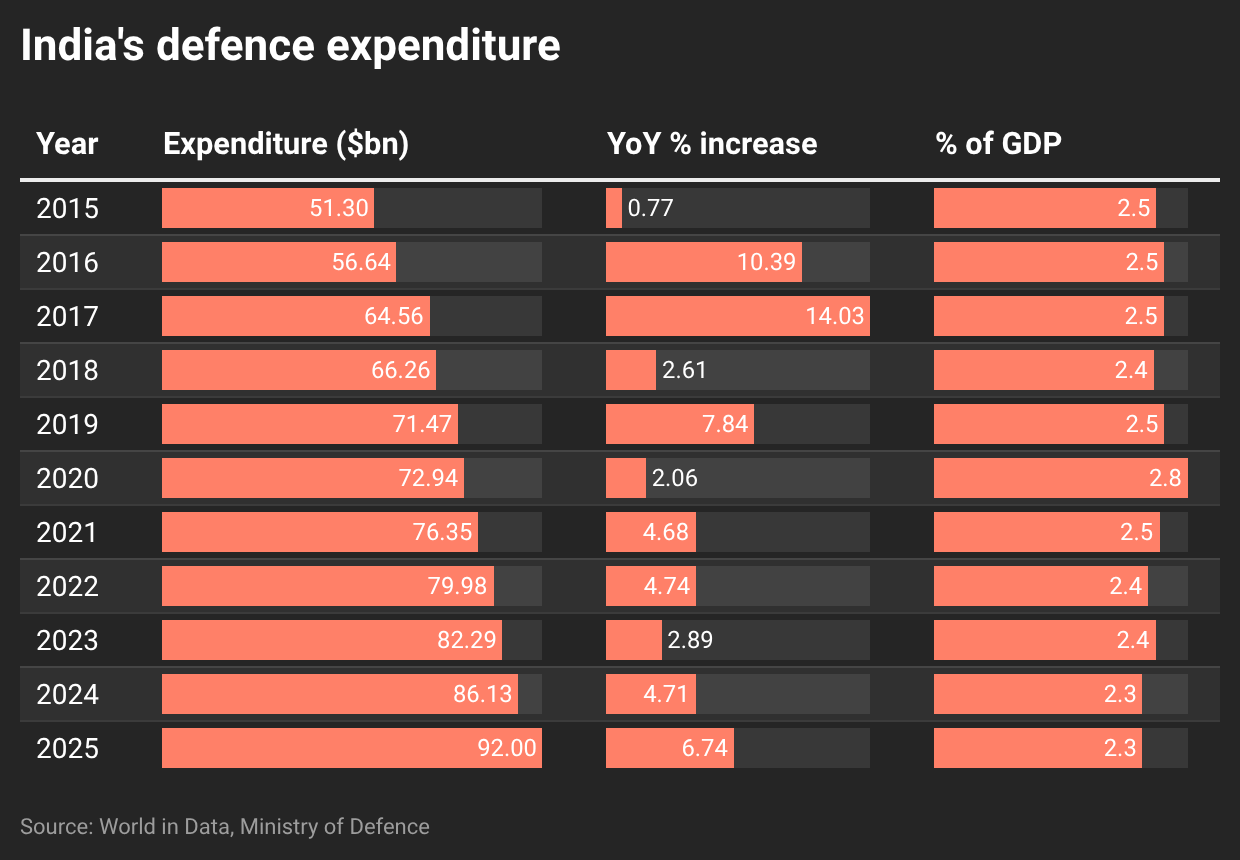
That rise matters because it suggests defence spending is being treated as a long-term commitment, not an occasional response to border tensions or war scares, as per the Morgan Stanley report.Defence capital expenditure, in particular, is being used to drive economic activity in sectors such as aerospace, electronics, precision engineering and materials.In other words, the money is not only buying military hardware. It is also building the industrial base that can sustain it.
Atmanirbhar defence
India’s defence strategy has increasingly been anchored in the idea of self-reliance, or Aatmanirbhar Bharat.The government wants to cut the country’s historical dependence on foreign military suppliers, which have included Russia, the US, France and Israel.That shift has been backed by several policy measures:The Defence Acquisition Procedure DAP 2020 introduced procurement categories such as “Buy Indian” and “Buy & Make Indian”, which favour domestic firms.
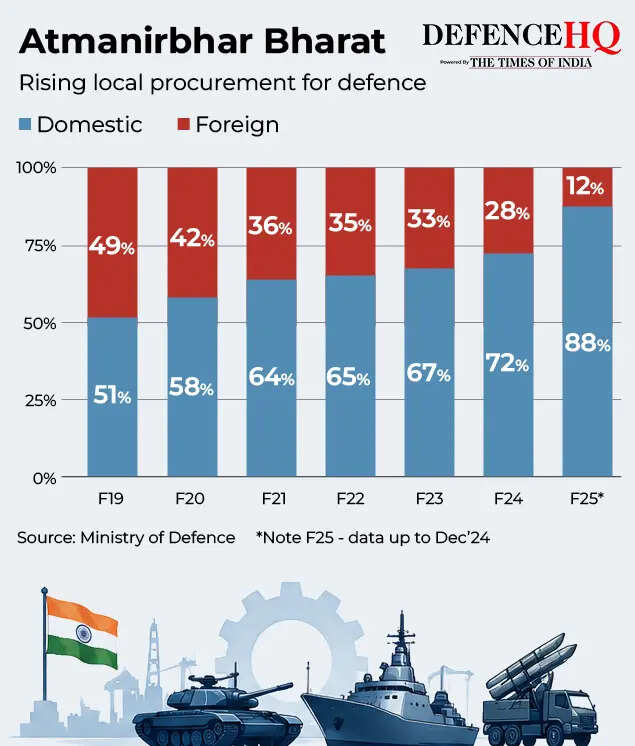
Positive Indigenisation Lists have banned imports of hundreds of defence items, including small arms, artillery shells and rockets, to push local manufacturing.Around 75% of defence procurement is now expected to come from the domestic market, while the private sector has been assigned a larger role.FDI rules have also been liberalised, with up to 74% allowed automatically in most defence subsectors.Two defence industrial corridors, in Uttar Pradesh and Tamil Nadu, are being developed to attract investment and strengthen production ecosystems.iDEX, the defence innovation programme, continues to support startups and technology firms working on next-generation military solutions.
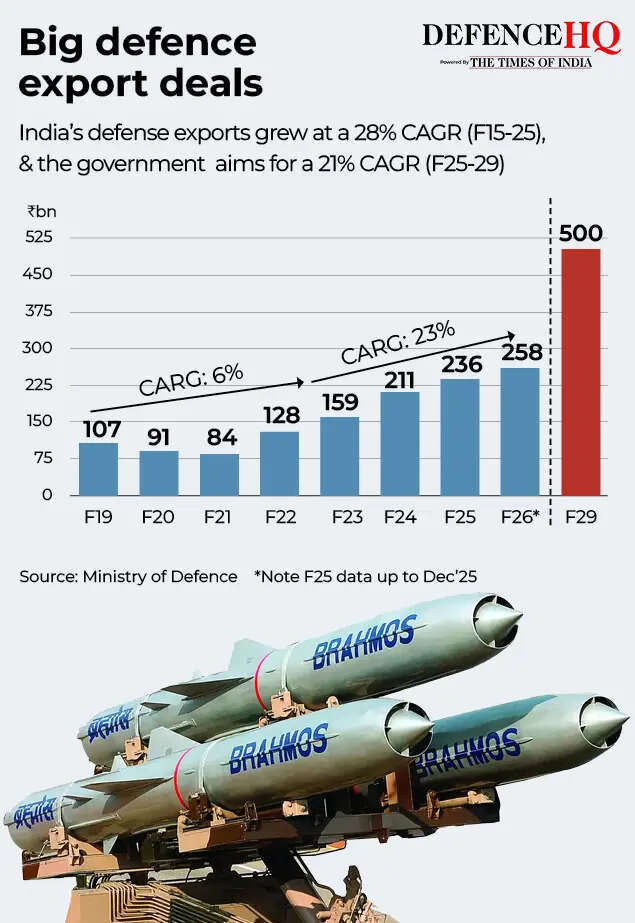
Export rules have also been eased to help Indian defence companies reach foreign markets.Together, these measures show a deliberate attempt to move India away from an import-heavy model toward one in which domestic firms can handle a larger share of production, upgrades and maintenance.
Why the shift now
The timing is no accident. India is facing a more demanding security environment, both regionally and globally.Wars and conflicts elsewhere have also exposed how fragile global supply chains can be, especially for defence components, electronics and specialised subsystems.For India, that means the old model of buying platforms from abroad and depending on overseas logistics is becoming riskier. Delays in deliveries, price shocks, spare-parts shortages and technology restrictions can all weaken readiness. Operation Sindoor reinforced the urgency of avoiding those vulnerabilities.There is also a strategic rationale.A more self-reliant defence ecosystem gives India greater freedom in crisis situations, fewer external constraints in military planning and stronger leverage in negotiations with foreign suppliers.
Industry responds
The policy push is already producing measurable results. Indigenous defence production reached about ₹15 lakh crore in FY2025, while defence exports rose sharply to about ₹3.84 lakh crore, up 63% year on year.Major platforms and systems such as BrahMos, Tejas fighter jet and the Akash missile system have become symbols of India’s growing ability to produce advanced equipment at home.
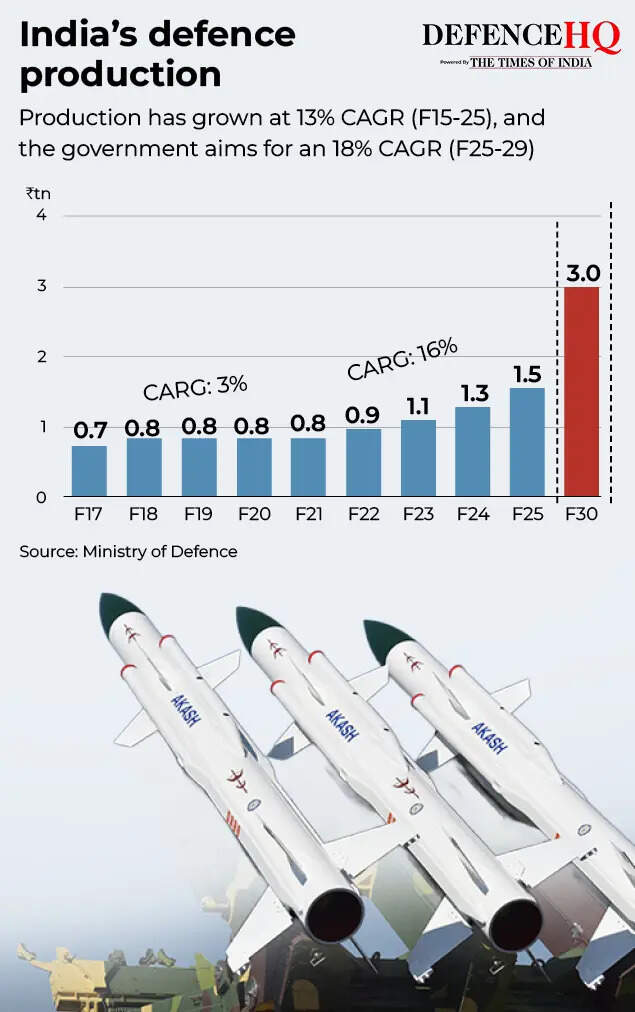
The progress is uneven, but the direction is clear: more of India’s defence needs are now being met by domestic industry than in the past.That matters because defence manufacturing has spillover effects. It supports precision engineering, avionics, electronics, metallurgy, software, drones and testing services. It also helps create high-skill jobs and deepen supply chains, especially when private firms are involved alongside public sector undertakings.
Persistent bottlenecks
The Morgan Stanley report notes that despite stronger policy support, India’s defence strategy still faces major constraints. The sector has long struggled with import dependence, weak local supply chains, quality-control issues and an ecosystem that historically concentrated orders in public sector companies.Those weaknesses have not disappeared.Critical subsystems such as engines, advanced sensors, semiconductors, propulsion systems and specialised materials still depend heavily on foreign sources. That means India can increase domestic assembly and integration, but true self-reliance will take time.There is also the problem of procurement execution.Defence contracts often move slowly, and delivery timelines can slip because of testing, certification, budget pacing or vendor delays. The results of higher spending will therefore depend not just on larger allocations, but on how quickly contracts are converted into actual capability.
Co-production and fast-track buying
To manage these gaps, India is using a dual approach. On one side, it is accelerating emergency purchases where quick delivery is essential. On the other, it is pursuing co-development and co-production with foreign partners.
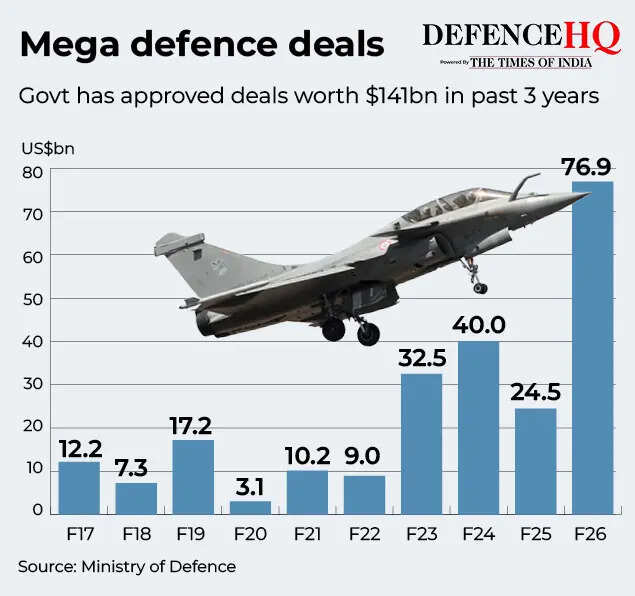
The logic is practical. India may not be able to indigenise every subsystem immediately, so it is trying to absorb technology through partnerships while building local capacity over time. Joint production efforts, such as work on jet engine technologies, reflect this strategy.This is a significant change from the older approach, which often relied on one-off imports with limited technology transfer. The new model is more deliberate: buy, learn, produce and scale.
Fiscal and economic trade-offs
A bigger defence budget also comes with costs. Defence already accounts for a large share of central government spending, and a sustained rise will put pressure on the fiscal balance unless offset by stronger revenues or spending restraint elsewhere.There are also external account implications. If a larger share of defence acquisitions still comes from abroad, imports could widen the trade deficit. But if domestic production rises, more of that money stays within the economy and supports Indian industry.That is why the government’s current approach matters. Defence spending is being framed not merely as consumption, but as capital formation. If execution improves, the sector could contribute to growth, industrial upgrading and export expansion at the same time as it strengthens national security.
A new strategic doctrine
The biggest change after Operation Sindoor is philosophical. India is no longer treating defence as a siloed military function. It is treating it as a pillar of national power, industrial policy and technological sovereignty.That means the future defence strategy will likely rest on three priorities: sustained higher spending, deeper domestic production and stronger technology partnerships. The goal is not just to buy a stronger military, but to create an ecosystem that can support it for decades.If India succeeds, it will not only improve battlefield readiness. It will also build a more resilient defence base, reduce external vulnerability and position itself as a more credible arms exporter.In that sense, Operation Sindoor may be remembered not only as a military event, but as a turning point in how India thinks about power, preparedness and self-reliance.