


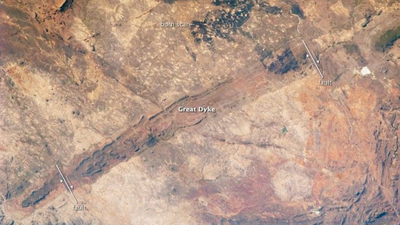
The 2.5 billion-year-old geological feature that exists in the Great Dyke of Zimbabwe is one geological feature whose importance has been recognised following an examination of it based on satellite imaging and geophysics mapping courtesy of NASA. The huge igneous formation existing in Zimbabwe provides important information about the early geology of the Earth, the creation of the Archaean crust, and magma systems. What makes the Great Dyke in Zimbabwe special is that it is 2.5 billion years old.
The Great Dyke of Zimbabwe: A geological archive of deep time
The Great Dyke is one of the most spectacular geological structures in the world, forming an almost straight line over 500 kilometres long in Zimbabwe. It was formed in the Archaean Eon, being a massive intrusion of magma which rose from deep inside the earth to form a rock body after many years of cooling under the surface. While the cooling was occurring at a slower rate than in surface lava flows, it enabled minerals to form crystals in different layers, thereby providing insight into history.Tectonic stability in the area ensured that the dyke was preserved for a considerable period of time. The structure is made up of layers whose formation was a result of changes in the physical environment inside the Earth billions of years ago.
The hidden 2.5-billion-year-old structure and its implications
Inside this formation, scientists have recently discovered an internal feature whose age is estimated to be around 2.5 billion years old. This internal structure is not visible on the surface, but it is present as a slight difference inside the dyke’s inner composition. Researchers who work with data funded by NASA believe that it might be an old magmatic pipe or a place where the magma was stored, then cooled, and chemically differentiated to form layers of minerals.While making observations for NASA’s Earth Science programs, scientists have stressed that:“Remote sensing and gravity data enable us to reveal subsurface heterogeneities related to early magmatic and tectonic events.”The importance of this internal structure lies in the fact that it reveals the behaviour of magma inside the crust. Instead of being uniform in structure, this dyke seems to exhibit complex features that indicate intense geological activity inside the dyke, such as repeated injections of magma and its subsequent chemical differentiation.
How satellite science is transforming geological discovery
It would have been almost impossible to locate such a deeply hidden structure using conventional field methods alone. Rather, modern-day science had to make use of satellite-based technology, using data collected from various satellite missions supported by NASA. Satellites equipped with special instruments are able to capture slight changes in the surface of the Earth, whether in terms of composition or temperature, thereby indicating what lies below.Using information provided by satellites along with gravity and magnetism, scientists were able to generate a comprehensive view of the subsurface area. It was through the anomalies in these data sets that scientists were able to infer the existence of a hidden structure inside the dyke. As is stated in some of the technical documents published by NASA,“Geophysical data sets integrated together offer an effective tool for unveiling hidden geological formations and their geological processes.”This technique marks a new era in geology, one where modern satellite technology complements more conventional techniques of study.
Why this discovery reshapes our understanding of early Earth
This finding has immense value for research concerning the formation of continents on early Earth. Due to the elevated heat flow of Earth’s core, the planet’s surface was more volatile in the Archean Eon. Features like the Great Dyke provide valuable information about those times, as they act as geological chronicles.The findings regarding the newly discovered structure point to a greater complexity of the magma systems during those periods than previously thought. As opposed to uniform intrusions into the crust, it seems that multiple layers, changes in chemical composition, and interactions with both the crust and mantle played their roles. This can be useful when refining the theories about the formation of terrestrial planets.Additionally, the Great Dyke is famous for its mineral deposits, such as platinum group elements and chromium, among others. Therefore, studying the inner features of this geological structure can be useful for the exploitation of minerals.The exposure of a structure estimated to be around 2.5 billion years old, concealed deep inside the Great Dyke, reveals how advanced technology has made it possible for mankind to gain deeper insights into the formation of Earth. By employing satellite imagery, geophysics, and the knowledge of geology, scientists who have been working under the guidance of NASA are finding out things that could never have been known before. Such structures will continue to serve as key areas of research in the study of Earth.